
Sit through a few project launches in Raipur and you will notice the word township doing a lot of work. A single tower on a small plot borrows the label. So does a plotted layout with one park and a gate. The confusion is old enough that Business Today flagged it years ago: India has no uniform definition of a township, and developers attach the name to projects covering as little as 25 acres.
The label matters because the two formats behave differently in almost every way that affects you. They differ in what you pay each month, how far you travel for school and groceries, and how your home holds value as the city grows. This guide lays out the differences so you can compare both formats on facts rather than brochures.
What Counts as a Township and What Counts as a Conventional Project
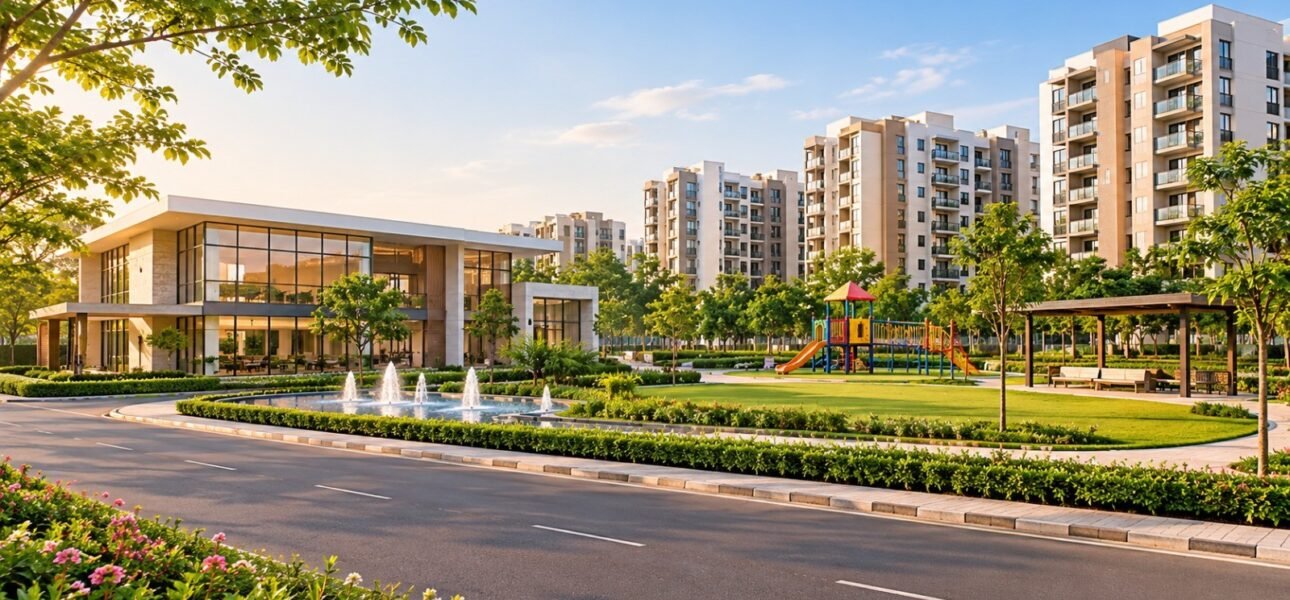
A township is a large, master planned development where homes, internal roads, shops, schools, healthcare and open spaces are designed together as one self sufficient layout, usually delivered in phases. A conventional residential project is a single building or society on a smaller plot that depends on the surrounding city for everything beyond its gate.
That difference in starting point changes everything downstream. A conventional project is planned inward: where the tower sits, how parking works, what fits into the clubhouse. A township is planned the way a small urban area is planned. Land is zoned for residential, commercial and recreational use before construction begins, and Business Today notes that even plot buyers inside a township cannot deviate far from the layout norms, which is what keeps the neighbourhood consistent over decades.
Chhattisgarh has seen this logic at full scale. Nava Raipur Atal Nagar was planned from open land as the state’s new capital, with sectors earmarked for housing, offices and greens before residents moved in (The Better India). The Raipur Development Authority applied a similar sector based approach in its Kamal Vihar town development scheme on the city’s outskirts (Business Standard). Most private launches in the city are still the conventional format, a tower or a society on one plot, which is what you will find across the majority of residential projects in Raipur.
Township in Raipur vs Standalone Project: The Core Differences
Put the two formats side by side, and a pattern emerges: a township in Raipur is judged by its layout, while a conventional project is judged by its building. Here is the comparison most brochures will not show you.
| Aspect | Township | Conventional Residential Project |
| Land parcel | Large, commonly 25 acres or more, though definitions vary (Business Today) | A few acres or a single plot |
| Planning approach | Master plan with separate zones for homes, retail, schools and parks | Building level plan within one plot |
| Construction timeline | Phased, often stretching 8 to 10 years (Business Today) | Single phase with one completion date |
| Internal infrastructure | Own road network, drainage, water and power planning | Relies on municipal services at the plot line |
| Amenities | Schools, clinics, retail and large clubhouses inside the layout | Gym, hall and garden shared by one society |
| Open space | Parks and greens reserved at the layout level | Limited to podium or perimeter gardens |
| Maintenance | Professional estate management across the campus | Society committee or a small agency |
| Community size | Thousands of residents across configurations | A few dozen to a few hundred families |
| Dependence on the city | Low for daily needs | High, since everything beyond the gate is the city’s |
The last row is the one to sit with. A standalone society borrows its liveability from the streets around it, so its quality of life rises and falls with the neighbourhood. A township carries its liveability inside the gate, which is a big part of why buyer interest in a township in Raipur has grown as the city has pushed outward.
Infrastructure Inside the Gate: Roads, Drainage and Open Space
This is the difference you feel daily, and it shows up most clearly in the monsoon. A conventional project connects to whatever municipal road, drain and water line passes its plot. On a good street in an established area, that works fine. On a developing stretch, it can mean waterlogged approach roads and tanker dependence for years after possession.
A township builds its own internal network. Roads, stormwater drains, sewage treatment, water distribution and power backup are planned at the layout level before the towers rise. The approach road may still belong to the city, but once you are inside, the quality of what you use every day is the developer’s responsibility rather than the municipality’s.
Two cautions apply. First, phased delivery means the infrastructure of later phases can lag, since townships commonly build out over 8 to 10 years (Business Today). Second, each phase is usually registered separately under RERA. Verify the registration and the promised completion date of your specific phase on the Chhattisgarh RERA portal, not just the project’s overall marketing timeline.
In Raipur, township scale land parcels sit mostly on the outer corridors: Saddu to the north, the belt near the new Vidhan Sabha, and the Raipur-Bilaspur Highway stretch. Expect genuine township launches there rather than inside the dense core, where plots of that size no longer exist.
Daily Life: Amenities, Maintenance and Community
Township marketing leans heavily on convenience, and the convenience is real. School drop inside the campus. A clinic within walking distance. Groceries without crossing a main road. For families with young children or older parents, removing those trips changes the texture of an ordinary week.
It comes at a cost. Residents fund private roads, campus wide security, horticulture and common lighting, so the monthly outgo runs higher than in a compact society, and the dense, community centred design trades away some privacy (Free Press Journal). Ask for the current maintenance structure in writing, and ask how it will change as later phases are handed over.
A conventional society flips that equation. Fewer amenities, but lower outgo, quieter common areas and a committee of neighbours instead of an estate office. Plenty of buyers prefer exactly that, especially second time buyers who already live near their schools, offices and relatives. Neither format wins outright. They suit different households at different stages.
What This Means for Property Value in Raipur
On appreciation, the published evidence leans toward townships. Outlook Money reports that integrated projects tend to show steadier appreciation than standalone developments, because the homes, shops and workspaces inside them keep reinforcing each other’s demand. Bizz Buzz, reviewing the segment nationally, found that integrated townships outperformed standalone residential projects on both price appreciation and rental yields.
Raipur adds a tailwind of its own. The state government is developing a State Capital Region that brings Raipur, Durg-Bhilai and Nava Raipur Atal Nagar under one integrated development plan (PTI, via The Week). As connecting corridors get roads and transit, large planned layouts along them are positioned to absorb that growth in a way a single building cannot. Developers with long delivery records in the city, Singhania Buildcon among them, have been planning newer launches in township formats along these corridors for exactly this reason.
One caveat from experience: location still beats format. A well placed conventional project in an established neighbourhood holds value through scarcity, because buildable plots in the core are nearly gone. Study the micro market first and the format second, whichever segment of real estate in Raipur you are weighing.
Mistakes Buyers Make When Comparing Real Estate in Raipur
After enough site visits, the same four errors keep appearing.
- Taking the label at face value. Ask for the sanctioned master plan and the total land area. If the township turns out to be one tower with a shopping strip attached, price it and judge it as a conventional project.
- Ignoring phase sequencing. The school and the big clubhouse in the walkthrough video may belong to a later phase that is years away. Check what is committed for your phase in its RERA filing and your agreement, with dates attached.
- Comparing on price per square foot alone. Township rates can run slightly higher than comparable standalone projects, and market coverage argues the built in conveniences offset that increment (DT Next). Whatever the gap, compare the full monthly picture: loan outgo, maintenance, fuel and travel time, not the rate card alone.
- Skipping the delivery record. A township asks you to trust a developer through a decade of construction. Their completed projects tell you more than any render, so visit an older one and look at how the roads, lifts and common areas have aged.
How to Decide Which One Suits You
Choose a township if you are planning a long stay, want daily needs inside the gate, are buying on an emerging corridor, and can live with phased delivery. Township layouts also tend to offer a wider spread of configurations on one campus, from compact 2 BHK flats in Raipur to larger homes and plots, which helps if you expect to upgrade within the same community later.
Choose a conventional project if you need possession now, want a lower monthly outgo, or value an established neighbourhood where the school, market and hospital already exist. If your timeline is immediate, ready to move flats in Raipur in a standalone society will usually serve you better than an early phase township booking.
Before booking either format, verify these five things:
- Sanctioned master plan and layout approval, not just the brochure map
- Phase wise RERA registration and completion dates on the state RERA portal
- A written amenity delivery schedule tied to your phase
- The maintenance structure and who runs it after handover
- The developer’s completed projects, visited in person
Treat the word township as the start of your questions, not the answer to them.
Frequently Asked Questions
Is every gated community a township?
No. A gated community refers to controlled access, which even a single building can offer. A township is defined by scale and master planning, with separate zones for housing, retail, schools and open space inside one layout. Since India has no single legal definition of the term, it gets used loosely in marketing (Business Today). Judge by the sanctioned plan and the land area, not the name on the hoarding.
How much land does a genuine township need?
There is no national standard, and state policies differ. Industry reporting notes that developers call projects as small as roughly 25 acres townships, while large integrated townships run into hundreds of acres (Business Today). A practical test: the layout should be big enough to hold homes, internal roads, retail and open space in separate zones. If everything fits on one plot, you are looking at a conventional project.
Do flats in a township cost more than a conventional residential project?
Township rates can be marginally higher than comparable standalone projects, and market coverage argues the amenities and conveniences make up the difference (DT Next). Maintenance also runs higher, since residents fund more shared infrastructure. Compare the complete monthly cost of living in each, including travel, before deciding what is actually more expensive for your household.
Where is township development happening in Raipur?
Mostly on the outer growth corridors where large land parcels are still available: Saddu, the belt near the new Vidhan Sabha, and the Raipur-Bilaspur Highway stretch. Nava Raipur Atal Nagar is the fully planned example at city scale (The Better India), and the proposed State Capital Region is expected to push more planned development along these corridors (PTI, via The Week). You can browse current property in Raipur options across both formats.
What should I check before booking in a township?
Five things: the sanctioned master plan, the RERA registration of your specific phase, a written amenity delivery schedule, the maintenance structure after handover, and the developer’s completed projects. Phase wise verification matters most, because townships are built over many years and your tower’s registered timeline is what binds the developer, not the project’s overall vision.
Sources
- Integrated townships a win-win for both developers and buyers, Business Today
- Integrated townships gain ground as urban buyers seek convenience over commute, Outlook Money
- Integrated residential townships are a growing trend, DT Next
- The future of Indian housing is in integrated townships, Bizz Buzz
- Proposed State Capital Region set to drive Chhattisgarh’s next phase of growth, PTI via The Week
- How Naya Raipur is emerging as one of the most well planned smart cities in India, The Better India
- What suits modern home buyers, Free Press Journal
- Chhattisgarh to develop model township (Kamal Vihar), Business Standard
- Chhattisgarh RERA portal